Always in the loop

As an actor in the plastic industry, it is our responsibility to ensure that the material remains in the loop and that our impact on the climate is as small as possible. We work with sustainability in all areas and our sustainability work is a natural part of our daily work, both in the short and long term. By actively working with sustainability at all stages, we create long-term growth and increased value for everyone who uses our products, but above all for future generations.

Our sustainability work is based on the Group's sustainability policy. This is based on the UN Global Compact, which comprises ten principles based on the UN Declaration of Human Rights, the ILO Fundamental Conventions on Human Rights at Work, the Rio Declaration and the UN Convention against Corruption.

Our sustainability work focuses on:

  • Climate emissions
  • Energy use and energy sources
  • Material use
  • Waste management
  • Employer branding
  • Quality
  • Financial result


Sustainability report

Since 2017, XANO has reported the Group's joint sustainability work in an annual sustainability report. When it was desired to have an overall picture of the sustainability activities in the group, a sustainability policy was developed centrally and implemented in all units. In 2018, the Board adopted a sustainability strategy that describes the overall direction for the continued work. Furthermore, targets were formulated for improvements in selected areas of the environment and personnel. Read more about our sustainability work in XANOs Annual report. 

Carbon footprint on item level

We have developed a model in collaboration with an external partner to calculate the carbon footprint of our products from raw material production to delivery from our warehouse (commonly referred to as "cradle to gate"). This initiative is part of Europe’s transition toward a more circular economy and aligns with the new EU legislation, the Ecodesign for Sustainable Products Regulation (ESPR). We are now working toward implementing climate impact calculations for all our CPX Standard products. Data is already available for most of our in-house manufactured products here on our website. The values represent climate impact in kilograms of CO₂ equivalents and include raw material production, transportation of raw materials, our manufacturing process, any additives, and transport to our warehouse in the country where the product is sold.

For customer-specific rotationally molded products, we can provide a tailored carbon footprint calculation for your specific product.

Read more about how we have calculated

Plastic is best from a life cycle and environmental perspective!

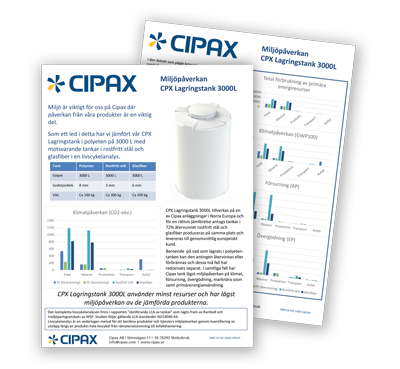
Ramboll have conducted an independent life cycle analysis reviewed by WSP where our products environmental impact from raw material to waste has been evaluated.

Products made of polyethylene, stainless steel and fiberglass were compared.

The result clearly showed that plastic (Polyethylene) has lowest effect on the climate and is the best alternative from a total environmental perspective.

Read the report

WE TAKE SUSTAINABILITY TO THE NEXT LEVEL

WE TAKE SUSTAINABILITY TO THE NEXT LEVEL BY USING 100% RECYCLED POLYETHYLENE IN THE MANUFACTURE OF CPX STANDARD PRODUCTS

Read the full story